
Historical Background
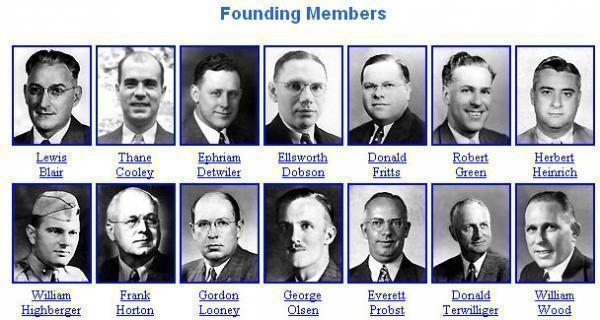
1. Frank R. Horton '26
2. Everett W. Probst '26
3. Thane S. Cooley '27
4. Ephraim M. Detwiler '27
5. William T. Wood '27
6. Lewis B. Blair '28
7. Gordon M. Looney '27
8. William W. Highberger '27
9. Donald L. Terwilliger '28
10. Donald H. Fritts '26
11. George A. Olsen '28
12. Robert J. Green '29
13. Ellsworth S. Dobson '28 and
14. Herbert Heinrich '27
2. Everett W. Probst '26
3. Thane S. Cooley '27
4. Ephraim M. Detwiler '27
5. William T. Wood '27
6. Lewis B. Blair '28
7. Gordon M. Looney '27
8. William W. Highberger '27
9. Donald L. Terwilliger '28
10. Donald H. Fritts '26
11. George A. Olsen '28
12. Robert J. Green '29
13. Ellsworth S. Dobson '28 and
14. Herbert Heinrich '27
Six advisors were also inducted, including four members of the Lafayette College faculty,
President John H. MacCracken,
Dean Donald B. Prentice
Professors D. Arthur Hatch and
Harry T. Spengler
One local Scouting official,
Herbert G. Horton and
One national Scouting official, National Director of the Boy Scouts of America,
Ray 0. Wyland.
The idea behind the founding of Alpha Phi Omega was that of Frank Reed Horton, Lafayette Class of 1926. During World War I, Horton served in the US Navy on the minesweeper USS Whippoorwill in the
Horton enrolled at
Horton decided there was a need for an organization that would strengthen former Scouts in their early ideals, develop friendship with other students who were former Scouts, and provide an opportunity for leadership and the rendering of service. Horton believed that such an organization, with chapters in the colleges of the nations of the world, would motivate national and international leaders to aspire to the organization's ideals and the settling of international disputes peacefully.
During his senior year in 1925, Horton founded Alpha Phi Omega. He selected the Greek words and their meaning, the motto "Be a leader, Be a friend, Be of service," and created the initiation ritual, the constitution, and by-laws. From 1925-1931, Horton served as Alpha Phi Omega's first national president. During this period, eighteen chapters were established. Horton served as editor of the first national publication, The Lightbearer, which he established in 1927 and which later became the Torch and Trefoil. The national organization was incorporated on January 11, 1927. By 1929 Horton secured a copyright from the United States Patent Office to protect the fraternity trademark and in 1930 he entered Alpha Phi Omega in the 12th edition of Baird's Manual, American College Fraternities.
The second chapter of Alpha Phi Omega, Beta, was established at the
Since the
inception of Alpha Chapter in 1925, membership records indicate active
participation in the Chapter until the early 1970s. By 1974 membership dwindled
until only one active member remained. The Chapter underwent a revitalization
and flourished until the 1980s, when interest in the Chapter declined.
Following a second brief reactivation in 1988, Alpha Chapter ceased to exist as
an active organization at Lafayette
College. While active,
Alpha Chapter provided service to both the college and community. It took an
active interest in local boys' clubs and Scout troops. During the 1930s, it
cooperated with Brainerd Society in distributing food and clothing to the local
needy. The Chapter contributed donations to the Jerry Lewis Telethon for
Muscular Dystrophy, the National Association for Retarded Children, and the
American Cancer Society. It participated in the Lafayette Alumni Phon-A-Thon
and sponsored swim and wrestling meets. Other services rendered by Alpha
Chapter included maintaining a portion of the Appalachian Trail, organizing
tuberculosis and blood drives, assisting with freshmen orientation, ushering
for theatrical performances, paper recycling, operating a campus lost and
found, and aiding campus student government elections. It also decorated Colton
Chapel at Christmas, raised charity money through the "Ugly Man"
contest, and contributed money to Lafayette
scholarship funds.

